Creative Specs
Part of CTV response paths
Choosing between a memorable URL and a QR code
Choose a QR code, memorable web address or both for a CTV ad, then check format support, readability and reporting limits.
Choose a QR code for a CTA viewers should act on while the ad is visible, such as comparing or enquiring, if the booked placement supports scanning. Choose a memorable web address when viewers may act during the ad or later; use both when either route suits the CTA and the screen can stay clear.
Compare what each route asks of viewers
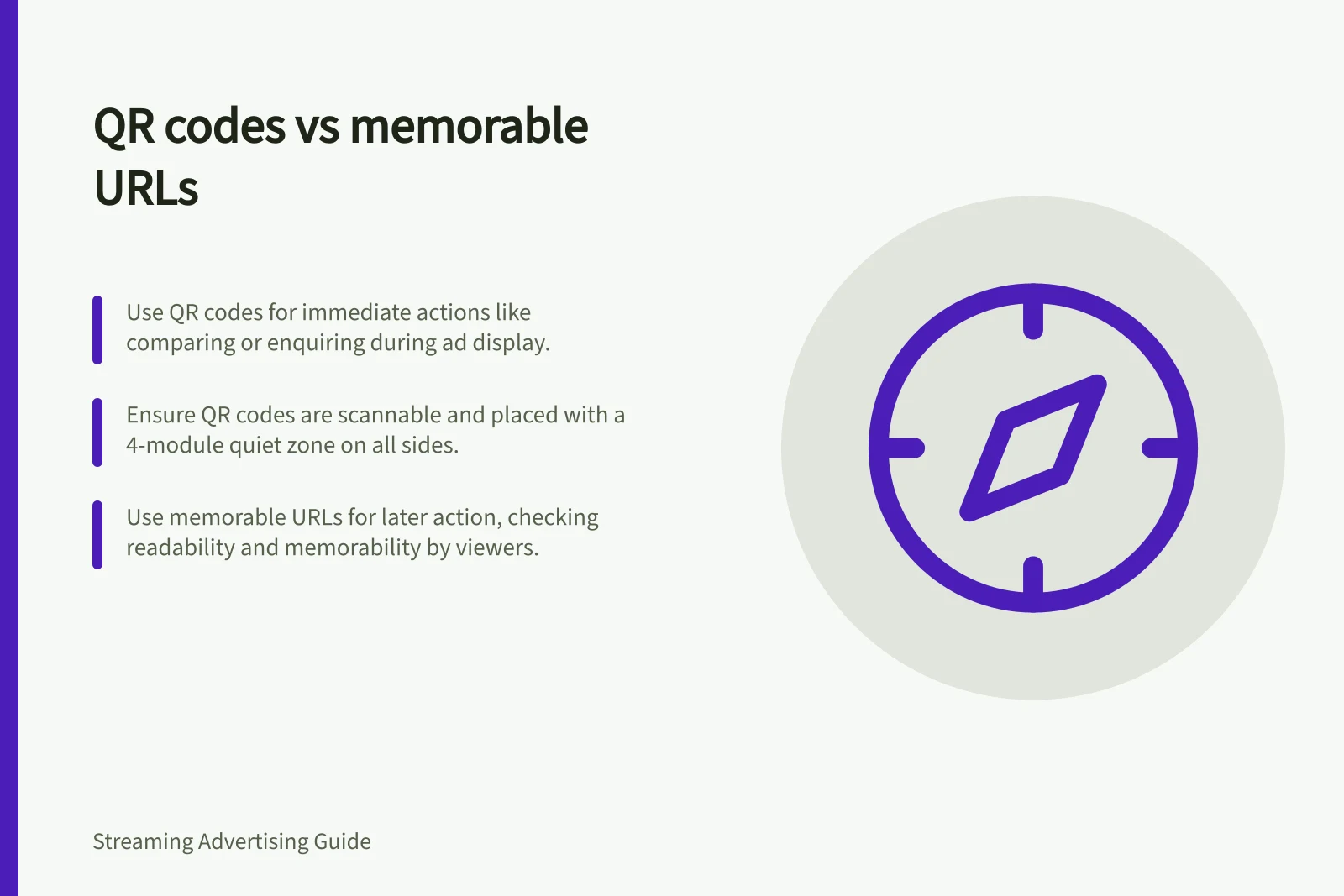
For a comparison or enquiry CTA intended for immediate action, a QR code lets viewers open a phone page while the ad is visible. Confirm that the booked placement supports QR codes and that the code remains scannable in the finished creative.
For a message viewers may consider later, use a memorable web address they can enter on a device. Check whether the intended viewer can read, hear, spell and remember the actual address.
A QR code can fail if it is absent, hard to scan or opens the wrong page; an address can fail if it is hard to read, hear, spell or remember. Check the rendered ad from an ordinary viewing position.
A tagged QR URL can record visits if its tag reaches analytics. A dedicated address can record requests, including repeat or shared use.
QR Code vs Memorable URL: Key Considerations for CTV Ads in Australia
- Best for Immediate Action
- QR code (when placement supports scanning)
- Best for Later Action
- Memorable web address
- Scanning Requirements
- Must be scannable; check placement preview and quiet zone (4 modules wide)
- Readability & Recall
- Address must be readable, spellable, and memorable by viewer
- Tracking Capability
- QR code: tagged URLs track visits; address: records requests including repeats/shared use
Pros and Cons of Using a QR Code vs. Memorable URL in CTV Advertising
- QR Code – ProsImmediate action during ad; direct tracking via tagged URLs; ideal for time-sensitive CTAs
- QR Code – ConsCan fail if not scannable, missing, or redirects incorrectly; requires device access and active scanning
- Memorable URL – ProsAccessible later; no need to scan; can be shared verbally or via text; records repeat visits
- Memorable URL – ConsMay be forgotten, misheard, or mistyped; depends on viewer’s ability to recall accurately
Check the format before designing the code
Before choosing a QR route, ask the supplier for the booked placement to confirm eligibility and provide a placement preview. The code needs to be present and scannable in that placement.
Keep a clear quiet zone four modules wide on every side of the code, as specified by DENSO WAVE. There is no universal television code size; check the rendered ad from an ordinary viewing position.
DENSO WAVE’s print example calculates a 9.398 mm square, including the margin, for a Version 3 code at 400 dpi. That print calculation is not a CTV screen-size target.
Keep the offer consistent
Use both when viewers may act immediately by scanning or later by entering an address, and the screen can show both clearly. Give viewers one main instruction and send both routes to the same offer content.
The routes can be tracked separately. Check redirects, campaign parameters, product details, conditions and the next action for each route.
Neither route proves exposure or causation: an address can be shared, and a QR destination URL can be forwarded. Label results as recorded route use and choose the simplest creative viewers can follow.
Recommended Workflow for Choosing and Implementing a CTV Ad Route
- Determine Action TimingImmediate (use QR) or delayed (use URL)
- Confirm Placement SupportCheck with supplier if QR code is allowed and visible in final render
- Design with Clear Quiet ZoneEnsure 4-module margin around QR code as per DENSO WAVE standards
- Use Both Routes When AppropriateOffer both QR and URL when audience may act immediately or later; send both to same offer
- Track and Label Results AccuratelyLabel data as 'recorded route use'; avoid claiming exposure or causation