Media Planning
Part of CTV campaign reviews
Choosing whether a CTV campaign should be repeated
Use the original objective, delivery quality, measurement coverage and next-flight cost to decide whether to repeat, revise or test a CTV campaign.
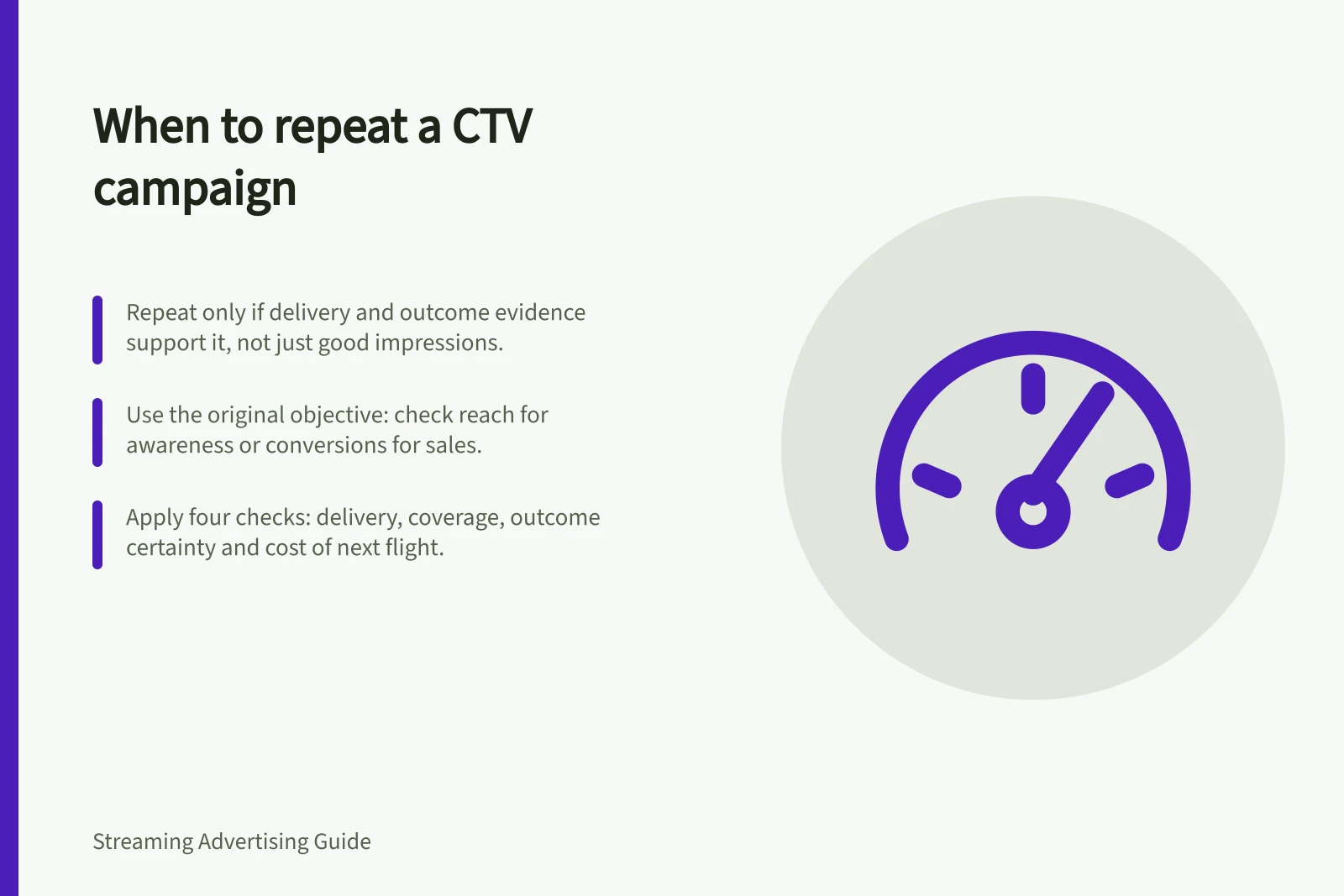
Repeat a CTV campaign only within the scope its evidence supports. The original objective still matters, delivery was sufficiently relevant to that objective, and the outcome evidence is strong enough for the next spending choice. Otherwise, revise a defined element or run a narrower learning flight. A favourable delivery metric alone does not settle the decision.
Return to the original job
Use the objective recorded before launch. For awareness, examine eligible reach and a suitable brand measure if one was planned. For enquiries or sales, use the defined business event and comparison method.
Keep impressions and completed plays as execution evidence; media, brand and sales effectiveness are separate measurement questions.
Decide exactly what a repeat would preserve: Australian service areas, audience rule, inventory, message, offer, timing and response path. Evidence from one set of conditions gives little basis for unqualified expansion into different locations or supply.
Apply four decision checks
- Delivery:Did the intended TV inventory, dates, audience boundaries and creative versions run? If not, can the outcome be interpreted for the delivered subset?
- Coverage:Which delivery and business activity entered the chosen measurement, and what remained unmatched or unmeasured?
- Outcome:What happened to the preselected measure, and how uncertain is the conclusion? An attributed action is not automatically an incremental one.
- Economics:What would another flight cost on the same advertiser-payable basis, including changed fees, production or measurement?
Set the minimum evidence and commercially meaningful outcome for this advertiser's choice; there is no universal repeat threshold. Attach a controlled comparison to the audience, period and intervention it tested. If only before-and-after trends are available, state that other activity could have influenced the change.
| Next move | When it fits | Record |
|---|---|---|
| Repeat within the measured scope | The objective remains relevant and delivery and outcome evidence support a similar flight | What will be booked, its cost ceiling and the result to monitor |
| Revise a defined element | A specific execution, offer or measurement problem has a plausible remedy | The change, owner and evidence that will assess it |
| Hold or test narrowly | A coverage gap or weak comparison could reverse the spending choice | The uncertainty, proposed test and decision point |
A revision is a proposal to assess, not a promise of improvement. If several elements change together, the next report may not explain which change mattered. Write the recommendation as an action with boundaries and the condition that would make the team reconsider it.
Four decision checks for repeating a CTV campaign
- 1. DeliveryDid the intended TV inventory, dates, audience boundaries and creative versions run? If not, can the outcome be interpreted for the delivered subset?
- 2. CoverageWhich delivery and business activity entered the chosen measurement, and what remained unmatched or unmeasured?
- 3. OutcomeWhat happened to the preselected measure, and how uncertain is the conclusion? An attributed action is not automatically an incremental one.
- 4. EconomicsWhat would another flight cost on the same advertiser-payable basis, including changed fees, production or measurement?
Next move options when deciding to repeat a CTV campaign
- Repeat within the measured scopeThe objective remains relevant and delivery and outcome evidence support a similar flight. Record: what will be booked, its cost ceiling and the result to monitor.
- Revise a defined elementA specific execution, offer or measurement problem has a plausible remedy. Record: the change, owner and evidence that will assess it.
- Hold or test narrowlyA coverage gap or weak comparison could reverse the spending choice. Record: the uncertainty, proposed test and decision point.