
Media Planning
Connected TV advertising for Australian brands
Plan an Australian CTV campaign by defining its goal, TV-screen inventory, audience, creative and measurement before booking.
Connected TV (CTV) advertising places internet-delivered video ads on a television screen. For an Australian brand, start with the audience and campaign goal, then check which services, devices and locations the proposed buy covers. The number of people using streaming services is not a forecast of people available to receive your ad.
CTV is part of online video. A broadcaster's stream may be watched on a TV, phone or laptop; only TV-screen delivery belongs in a CTV plan. Internet video can reach a TV through a smart TV app, streaming device or games console. Ask suppliers to separate TV-screen delivery from other devices in both proposal and report.
CTV vs. Other Video Delivery: What’s Included?
- Connected TV (CTV)Ads delivered on a television screen via internet-connected devices (e.g., smart TVs, Apple TV, Roku)
- Online Video (Non-CTV)Ads viewed on phones, tablets, laptops – even if streamed from the same platform
Decide what the campaign should change
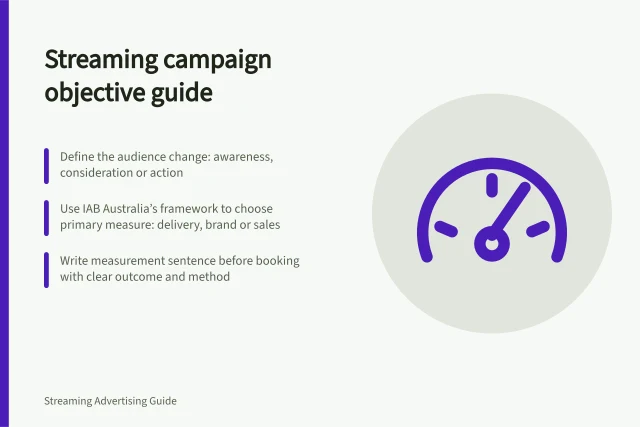
Give the campaign one primary job. If people need to learn the brand exists, plan for reach among the intended audience and decide how awareness will be assessed. If they know the brand, the message might explain a product choice or invite a visit to a relevant page. If the goal is enquiries or sales, define the action and how it will be recorded before booking media.
Keep delivery and outcomes distinct. Impressions, completed plays and estimated reach describe delivery or audience coverage. A brand study or recorded site action answers a different question. A conversion reported after ad exposure does not, by itself, show the ad caused it.
Agree how measurement will be used
IAB Australia's Video Measurement Framework groups video assessment into delivery quality, brand impact and sales outcomes. Use these categories to agree which questions the campaign needs to answer, rather than treating a single metric as a complete account of performance.
The framework describes approaches including attention measurement, brand lift studies, attribution, incrementality testing and marketing mix modelling. These methods answer different questions and have different data requirements. Establish with the supplier which approach is planned and what information it requires before the campaign begins.
Match the buy to Australian viewing
ACMA research describes streaming as Australia's favourite way to watch or listen. Request a forecast for the actual inventory, audience, geography and dates you intend to buy.
For each proposed package, establish which publishers or apps are included, whether delivery is restricted to TV screens, and whether inventory is live, on demand or a mixture. Ask what can be reported by publisher, device and location. If a requested breakdown is unavailable, decide whether the remaining evidence is sufficient for your goal.
Shared-TV viewing can make audience estimates complex. For detailed household audience planning, see the dedicated audience-planning article.
Key Australian CTV Viewing Trends
- Streaming Preferred by AustraliansACMA research shows streaming is Australia's favourite way to watch or listen
- CTV DefinedInternet-delivered video ads on a TV screen via smart TV apps, streaming devices, or gaming consoles
Recognise the range of Australian inventory
Australian BVOD examples include 7 Plus, 9 Now, 10 Play, Foxtel Go and SBS On Demand, which offer free-to-air content for streaming live or on demand. These are examples of services, not a complete list of CTV inventory. Confirm which services are in the proposed buy and what each contributes to the plan.
Prepare the message and response
Write for television viewing: make one main point, keep on-screen information readable, and provide a practical next step if a response is wanted. Interactive options depend on the booked placement. Obtain the supplier's creative requirements and a placement preview before approving the ad.
Make the destination match the ad's promise. If the message asks viewers to compare options, the landing page should present those options clearly. Check screen legibility, page loading and the next action before launch.
Check creative format fit across placements
Creative requirements can vary by environment and placement. IAB Australia's Video Format Matrix maps format characteristics and placement types across CTV, mobile and desktop, and provides guidance on adapting or reusing creative across them.
Use the matrix as a prompt when discussing whether an existing video can be used in the proposed placements or needs adaptation. Confirm the actual format requirements with the supplier; a creative that works in one environment may not fit another.
Put the decisions in one brief
A workable CTV brief states:
- the primary objective and intended audience;
- the Australian locations and campaign dates;
- the permitted TV-screen inventory and any excluded environments;
- the message, creative versions and intended next action;
- the reach unit, reporting breakdowns and outcome measure;
- the questions the supplier must resolve before booking.
After launch, compare delivery with the brief and record gaps in coverage.
Planning an Australian CTV Campaign: Key Steps
- Define primary objective and target audiencee.g., brand awareness, consideration, conversion
- Confirm Australian TV-screen inventory onlyEnsure delivery is restricted to TV screens, not mobile or desktop
- Agree measurement frameworkUse IAB Australia’s Video Measurement Framework: delivery, brand impact, sales outcomes
- Prepare message and responseEnsure landing page matches ad promise; test loading and legibility
- Verify privacy complianceConfirm data handling aligns with Australian Privacy Principles (APPs)
Include privacy in data discussions
If a campaign uses personal information for targeting or measurement, ask the supplier what information is collected, how it is used and disclosed, and who is responsible for handling it. The Australian Privacy Principles cover collection, use and disclosure, governance and accountability, information integrity and correction, and individuals' access rights.
The OAIC describes the 13 Australian Privacy Principles as applying to organisations and agencies covered by the Privacy Act. Ask how the proposed data practices address the relevant responsibilities. Clarify what information will be available for reporting without assuming household or device data identifies an individual viewer.
Pros and Cons of Using Personal Data in Australian CTV Campaigns
- ProsMore precise targeting, better attribution, improved personalisation
- ConsRisk of non-compliance with Australian Privacy Principles, potential loss of trust, legal exposure under Privacy Act
In this guide
- Connected TV versus online video advertisingCompare CTV with broader online video by screen, creative task, response path and reporting unit before choosing a buy.
- Choosing a streaming campaign objectiveChoose one primary streaming campaign goal and match awareness, consideration or action to an appropriate measure.
- Matching a CTV audience plan to household viewingPlan CTV audiences around household viewing by checking identity units, co-viewing, targeting eligibility and forecast coverage.