Media Planning
CTV and broader media planning
Give CTV a clear role alongside broadcast TV and other channels, compare coverage carefully, coordinate messages and plan evidence for the whole campaign.
Give connected TV (CTV) a clear job in the wider campaign. Start with the audience and outcome, check what existing channels already cover, then decide whether streaming should extend coverage, reinforce a message or support another stage of the customer journey. Record how the combined plan will be assessed before booking.
Know the Australian CTV audience
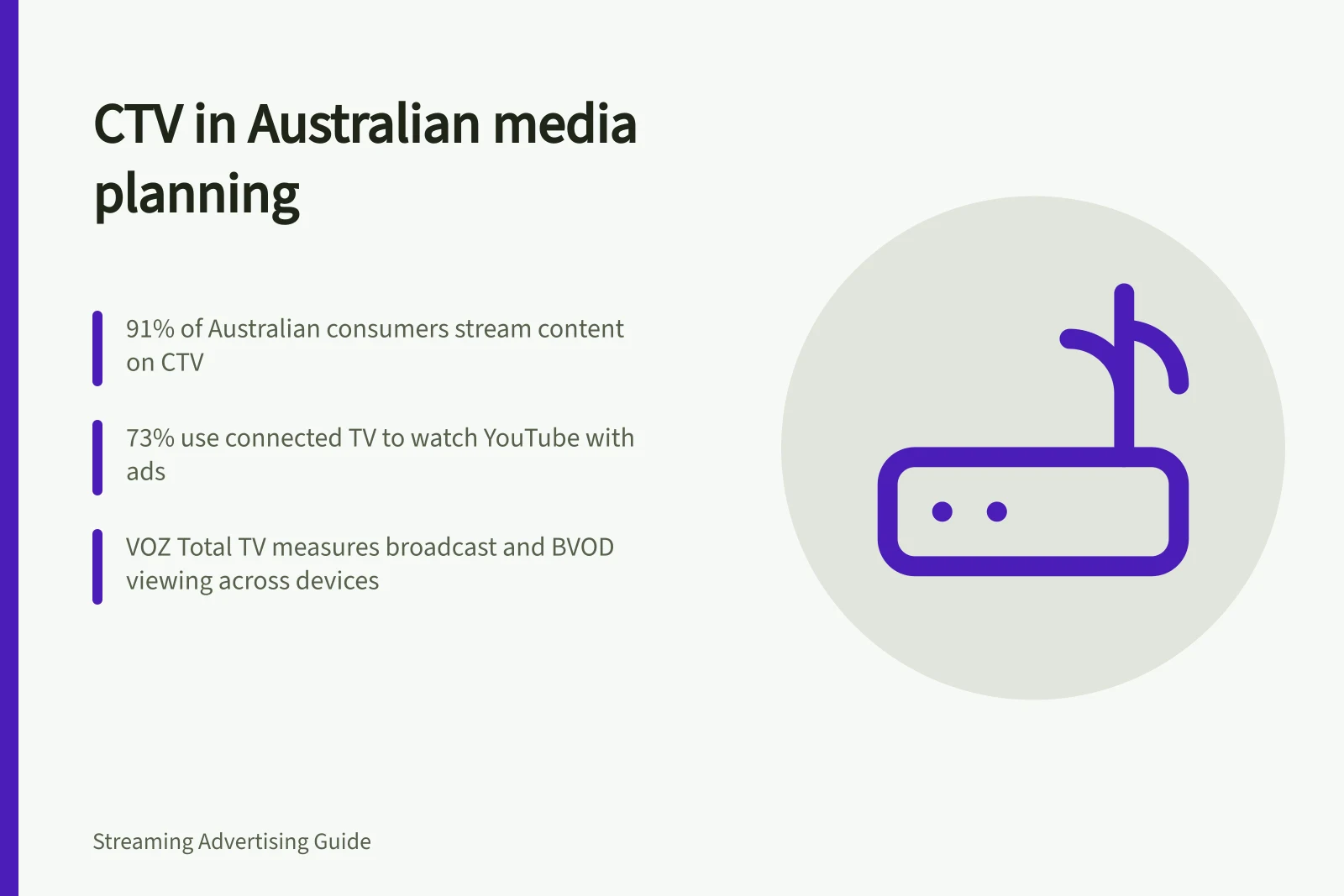
Australian CTV viewing is broad: 91% of consumers surveyed stream content on CTV, and 73% use a connected TV to watch YouTube with ads. Among CTV users, 97% have access to a paid subscription to ad-free platforms, so ad-supported viewing sits alongside paid services.
94% of Australian consumers say features of the CTV ad experience make it better than linear TV. They cite the ability to skip ads, fewer ads and shorter ads.
Key Australian CTV Audience Insights
Give each channel a job
Broadcast TV might introduce a broad message. CTV might reach viewers outside the existing schedule or carry a related explanation. Search, social, email and the website can help people explore or act. These are possible roles, not guaranteed strengths of those channels.
Write one sentence for each channel’s proposed role. If two channels share the same job, ask what each adds. Choose measures that match the job: delivered impressions, estimated reach, brand response and recorded enquiries answer different questions.
| Planning decision | Question to settle |
|---|---|
| Audience | Which people or households matter, in which Australian locations and dates? |
| Coverage | What does the existing TV schedule cover, and what might the specified streaming buy add? |
| Message | Which promise and conditions must remain consistent? |
| Response | Where can viewers complete the next step the ad offers? |
| Measurement | What can each channel report, and how will the campaign outcome be assessed? |
50% of marketers reported better ROI when using a multi-channel strategy across native, display video, CTV, audio, in-game and digital out-of-home. 40% of marketers planned to increase ad spend to drive ROI.
CTV can carry a response role: 64% of businesses run direct response campaigns on CTV. After viewing a CTV advertisement, 40% of consumers in a global survey had downloaded a mobile app, rising to 50% in North America; 53% were likely to download apps using QR codes shown in CTV ads.
93% of viewers use a secondary device while watching TV, and 71% hold their smartphone while watching TV.
Unlike traditional TV, which mostly relies only on demographics and geography, CTV allows advertisers to target audiences more precisely. 86% of consumers are willing to see ads on CTV.
Compare coverage on a common basis
Use the same audience, geography, period and identity unit when comparing plans. A CTV household estimate cannot be added to a broadcast person-reach estimate. Separate publisher forecasts also cannot be added to produce a unique campaign audience without a method for estimating overlap.
Australia’s VOZ Total TV measurement covers viewing by people via broadcast TV and/or BVOD, including BVOD on any connected device. Check whether a VOZ result suits the channels and audience in the plan; do not assume it represents viewing on other streaming apps. Public viewing overlap differs from overlap between this campaign’s ads.
Where a suitable combined estimate is unavailable, show each channel’s reach separately and mark cross-channel overlap unknown.
Broadcast TV is broadcaster linear content received over-the-air via aerial, satellite or cable, viewed on an in-home TV set. It can be watched live, as-live or time-shifted.
CTV inherited much of digital advertising’s identity infrastructure, but television viewing looks very different from the open web.
Coordinate the message
Keep the product, offer and important conditions consistent while adapting the explanation to each format. Agree when each version and destination changes. A streaming ad should not keep promoting an offer after the website stops explaining it. Check that the destination fulfils the ad’s promise and that qualifications do not contradict its overall impression.
The ACCC can require businesses to back up claims they make about products or services, and may investigate and take compliance or enforcement action if a business misleads. It does not resolve individual disputes or provide legal advice.
Plan the evidence with the buy
Keep channel delivery and the campaign outcome in separate parts of the report. Delivery shows what ran, when and within which reported inventory. The outcome section uses the brand or business measure chosen before launch and records other activity that could affect it.
An action credited to CTV under attribution rules is not necessarily an action caused by CTV. A causal contribution claim needs a suitable comparison or test. Approve the plan when channel roles, eligible inventory, message timing, reporting units and unresolved overlap are visible together.
Brand awareness, ad recall and brand consideration are outcome measures, not delivery measures. CTV campaigns that incorporate native and mobile video ads have been associated with increases in these brand metrics.
In this guide
- Comparing CTV reach with existing television coverageCompare CTV and existing TV reach using matching audiences, dates and units, and check whether an incremental-reach estimate covers the actual buy.
- Coordinating streaming messages with other campaign channelsKeep a streaming campaign’s promise, timing and next step consistent across TV, search, social, email and the destination.
- Estimating duplicated exposure across video channelsDefine a common audience and period, obtain an overlap estimate, and calculate combined video reach without double-counting viewers.
- Separating CTV execution metrics from whole-campaign outcomesReport CTV delivery against its brief, then assess the campaign’s chosen brand or business outcome with a separate method and clear limits.