Incrementality
Part of CTV and broader media planning
Separating CTV execution metrics from whole-campaign outcomes
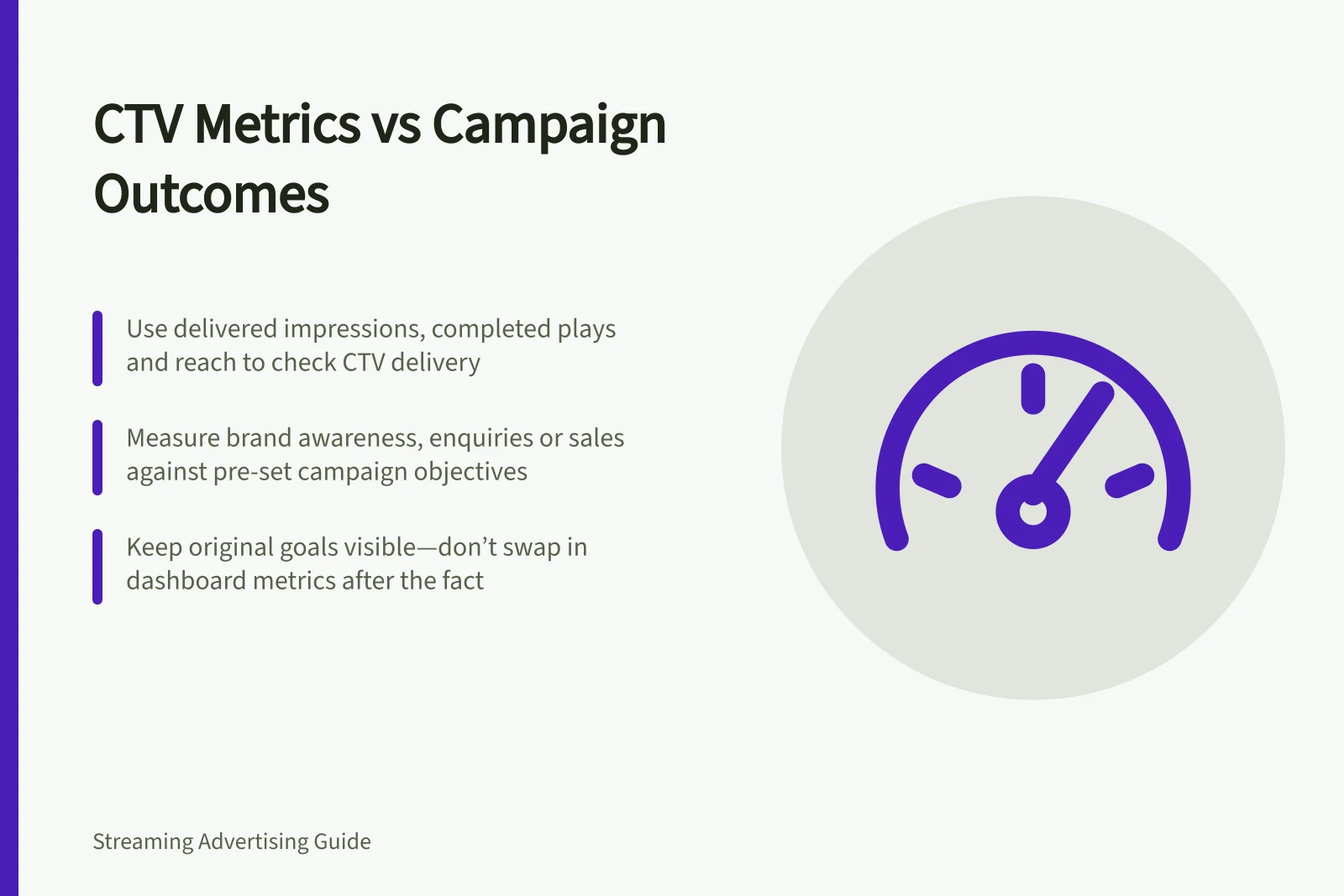
Report CTV delivery against its brief, then assess the campaign’s chosen brand or business outcome with a separate method and clear limits.
Use CTV execution metrics to check whether the streaming buy ran as planned. Use the campaign’s chosen outcome measure to assess the wider effort. Delivered impressions, completed plays and estimated CTV reach can reveal delivery or coverage problems; none alone establishes a change in awareness, enquiries or sales.
Keep two questions in the report
The execution section compares the approved CTV brief with reported delivery: dates, eligible TV-screen inventory, creative versions, impressions and any available reach or frequency estimate. State each metric’s counting rule and identity unit. Device, household and modelled-person figures are not interchangeable.
The outcome section restates the objective chosen before launch. It may show a suitable brand measure, recorded enquiries or sales, and the comparison method used to interpret change. Put other campaign activity and material business changes beside the result.
| Question | Evidence | Supported conclusion |
|---|---|---|
| Did CTV run within the brief? | Reported delivery, dates, devices, inventory and versions | Execution within reported coverage |
| What audience did measured CTV reach? | Reach and frequency with method and identity unit | Estimated coverage under that method |
| What happened to the campaign outcome? | The preselected measure and suitable comparison | An observed or estimated result within the design’s limits |
CTV Execution Metrics vs. Whole-Campaign Outcomes
- Question
- Did CTV run within the brief?
- Evidence
- Reported delivery, dates, devices, inventory and versions
- Supported conclusion
- Execution within reported coverage
- Question
- What audience did measured CTV reach?
- Evidence
- Reach and frequency with method and identity unit
- Supported conclusion
- Estimated coverage under that method
- Question
- What happened to the campaign outcome?
- Evidence
- The preselected measure and suitable comparison
- Supported conclusion
- An observed or estimated result within the design’s limits
Key Metrics in CTV Campaign Evaluation
- Delivered Impressions
- Reported against approved CTV brief
- Completed Plays
- Indicates engagement quality, not causal impact
- Estimated CTV Reach
- Based on device, household, or modelled-person identity units
- Attributed Actions
- Platform-specific credit rules apply; not equivalent to total sales
Explain mismatches without changing the objective
If CTV delivery falls short, investigate the operational cause before interpreting the outcome. If it delivers within scope but the outcome is weak, review the offer, message, destination and other channels. These checks identify possible explanations; they do not isolate CTV’s effect.
If sales rise while CTV delivery is below plan, report both facts without assigning the rise to CTV. A strong completion rate likewise does not replace the agreed business question. Keep the original objective visible in the final review rather than choosing a favourable dashboard metric afterwards.
Label attributed actions separately
A platform may credit a recorded action to eligible CTV exposure under its matching, window and credit rules. That count covers only the inventory and events its method can join. It is distinct from total campaign sales and from sales caused by CTV. A causal contribution claim needs a suitable comparison or control and a stated tested population.
End the review with four answers: whether CTV delivered within the approved scope, what its reach estimate covers, what happened to the chosen whole-campaign outcome, and what remains unknown. Those answers support a decision to repeat, revise or test further.
Reporting Process for CTV Campaigns in Australia
- Confirm CTV delivery against the approved briefCheck dates, eligible TV-screen inventory, creative versions, impressions, and reach/frequency estimates using defined counting rules.
- Assess the chosen campaign outcomeUse a preselected business or brand measure (e.g., sales, enquiries) with a valid comparison method, isolating external factors.
- Label attributed actions separatelyDistinguish platform-reported attributed actions from total campaign outcomes; avoid claiming causation without control groups.