Household Reach
Part of CTV campaign budgets
Estimating a test campaign's reach with explicit assumptions
Build a bounded Australian CTV reach scenario from media cost, eligible impressions and average frequency, then check the seller’s forecast.
Start with the media and included buying budget, a matching all-in CPM, the share of impressions eligible for the intended TV audience, and an assumed average frequency to estimate a CTV test’s reach.
Divide eligible impressions by that frequency to get a scenario in the same identity unit. Ask the seller for a forecast based on the actual Australian buy before treating the result as a planning estimate. The worksheet is not measured reach or a delivery promise.
Define the unit and eligible delivery
Choose households, devices or modelled people before calculating. A household estimate does not identify which resident watched a shared TV. Keep the apps, TV-device rule, locations, audience and dates with the estimate. A video forecast that also includes phones or computers cannot be presented as TV-only reach without separating eligible delivery.
Ask what the forecast includes and what it leaves out. If a quoted package contains delivery outside the intended audience or geography, obtain an evidence-based eligible share. The share cannot be borrowed from a general streaming-audience statistic.
Work through a scenario
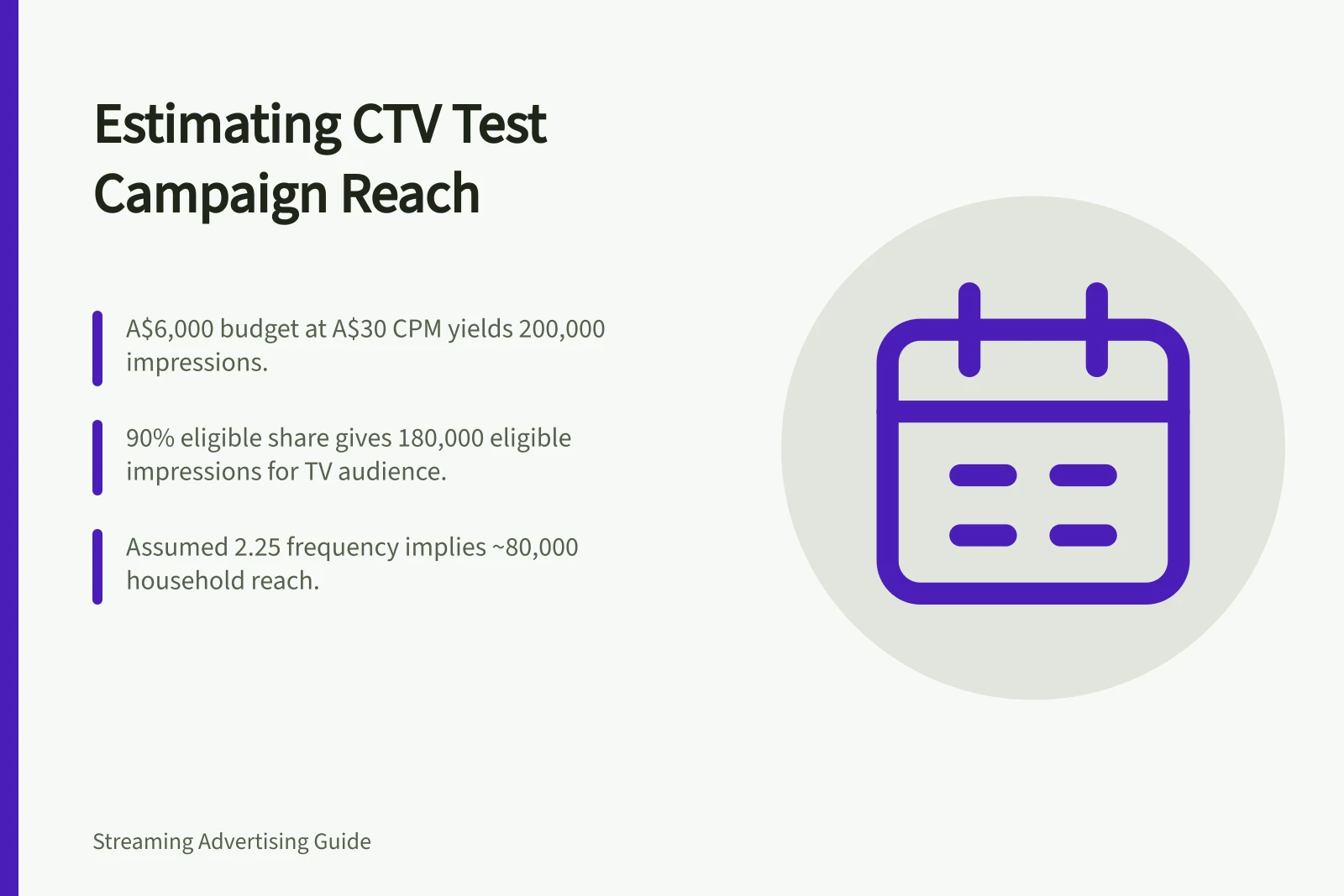
All figures below are invented. Suppose A$6,000 is available for media and included buying costs at an assumed all-in A$30 CPM. That gives 200,000 impressions.
Assume 90% meet the stated TV-screen, location and audience rules: 180,000 eligible impressions. If those impressions average 2.25 per reached household over the flight, the implied reach is about 80,000 households.
| Scenario | Eligible impressions | Assumed household frequency | Implied household reach |
|---|---|---|---|
| Base assumptions | 180,000 | 2.25 | About 80,000 |
| More concentrated delivery | 180,000 | 3.00 | About 60,000 |
| All-in CPM of A$36; other assumptions unchanged | 150,000 | 2.25 | About 67,000 |
These are sensitivity calculations, not three forecasts. The 90% share and frequency values have not been observed. The impressions and frequency must describe the same covered inventory, period and household unit.
Average frequency does not mean each household receives the same number of ads. If the eligible household pool is smaller than the implied reach, revise the assumptions.
Check against supplier evidence
Request a forecast for the exact inventory, dates, geography, audience and TV devices. Ask for its reach unit, eligible impressions, average frequency, deduplication method and coverage.
Keep a forecast’s reach unit explicit: a unique-reach figure should not be presented as household reach unless the seller confirms it measures households. Obtain a household forecast from the seller if households are the decision unit.
Do not add publishers’ unique-household figures when the same homes may use both services. Keep supply outside a forecast’s coverage out of its reach claim. If the test aims to assess response or brand change, check whether that measurement is feasible separately; reach arithmetic does not establish statistical power or business impact.
Before booking, vary CPM, eligible share and frequency to see which assumption changes the decision. After launch, compare delivered impressions and reported reach only for matching units and settled periods. Reporting availability and timing vary by seller and method; confirm these before comparing.