CTV Inventory
Part of CTV campaign budgets
Comparing quoted CTV CPMs on a consistent basis
Compare Australian CTV CPM quotes by impression unit, inventory, fees, tax basis and total buyer cost before choosing an offer.
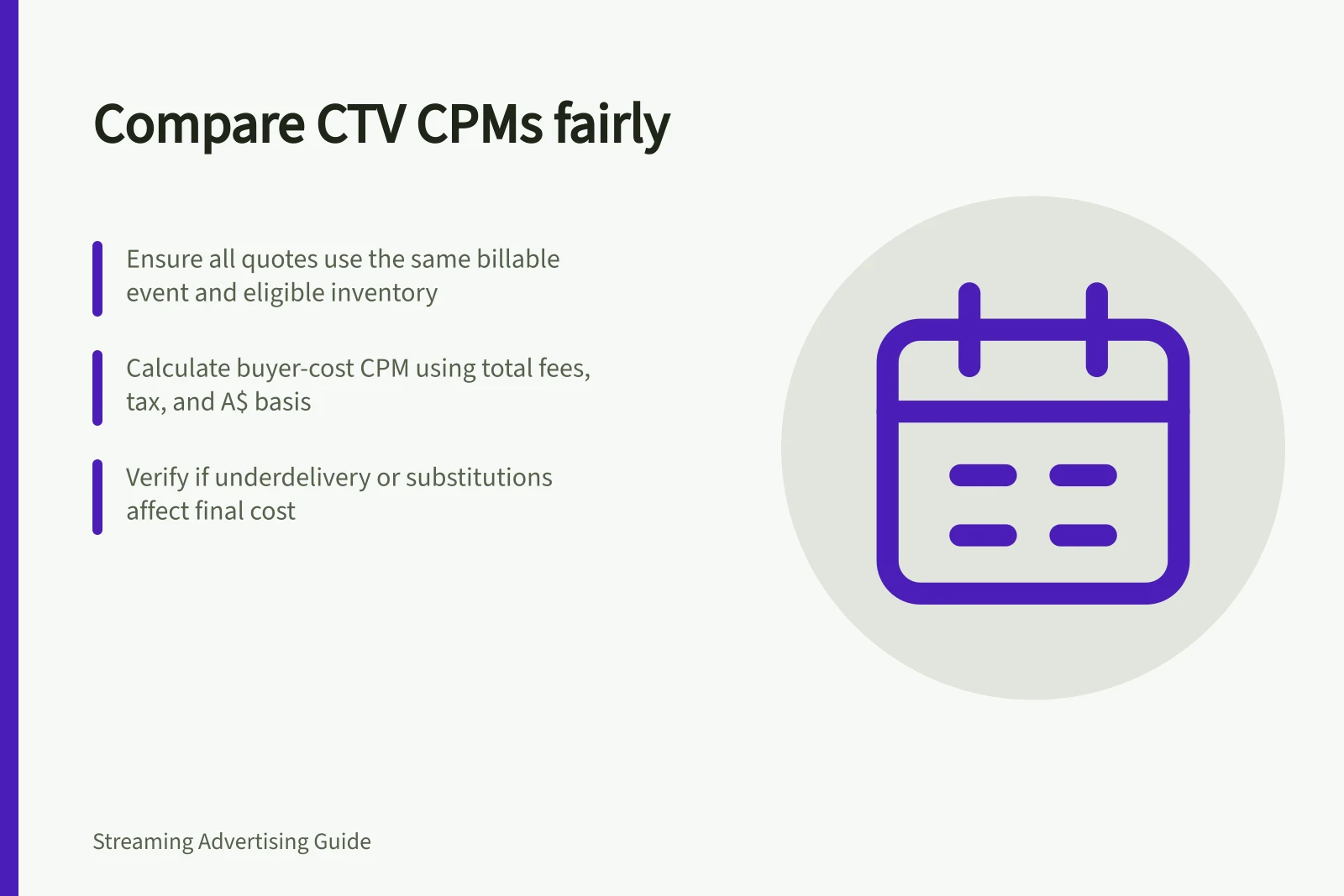
Compare CTV CPM quotes only once they describe the same billable event, eligible inventory and buyer cost. Put every proposal on the same Australian-dollar and tax basis, then calculate the amount payable per thousand comparable impressions. The lowest media-only CPM need not be the lowest total buying cost.
Establish what each quote buys
Ask what the rate counts: served impressions, viewable impressions or another specified event. A rate per thousand completed views has a different denominator from a rate per thousand served impressions. Keep unlike units in separate columns rather than converting one without evidence.
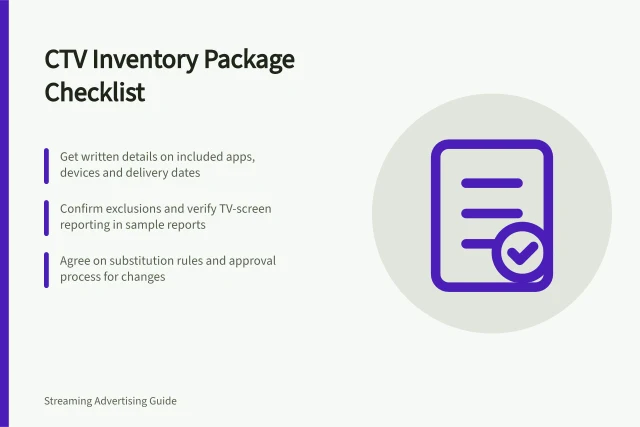
Record the apps or publishers, TV-screen requirement, locations, audience, creative duration and dates. State whether the quoted volume is committed, forecast or merely available to bid on. Do not assume a quoted platform bid is the client’s final CPM; check whether data and other service fees are included.
Steps to Compare CTV CPMs Consistently in Australia
- Confirm the billable event (e.g., served, viewable impressions)Ensure all quotes use the same denominator for impressions.
- Verify eligible inventory (apps, publishers, device types)Check TV-screen requirement and Australian audience coverage.
- Identify included fees (media, platform, data, verification)Confirm whether GST and other charges are included or separate.
- Reconcile post-deliveryMatch invoice and report to agreed cost basis and impression unit.
Calculate the buyer-cost CPM
Request media, platform, agency, data, serving and verification charges, with each fee’s basis. Confirm currency, tax treatment and whether a fixed charge changes with volume. For like-for-like impressions, buyer-cost CPM = total quoted buying cost ÷ quoted billable impressions × 1,000. Show one-off creative production separately in the total campaign budget rather than hiding it in a recurring media rate.
Ask which cost fields and markups are included in the reported amount, and reconcile tax separately where applicable.
The following illustrative quotes are hypothetical worked examples, not market rates. They assume the same eligible impression definition and volume, with both CPMs shown before tax:
| Illustrative quote | Media CPM | Additional buying costs | Buyer-cost CPM |
|---|---|---|---|
| A | A$24 | 20% of media (A$4.80) plus A$1.20 per thousand | A$30 |
| B | A$29 | Included in the stated price | A$29 |
Under those assumptions, B is A$1 cheaper per thousand. The figures are not market rates. If B has different apps, TV-device coverage or delivery terms, the arithmetic alone cannot choose the offer.
Compare risk and reconcile the result
Ask how each seller handles underdelivery, substitutions and any minimum commitment. Check which publisher and device breakdowns can be reported. Show total proposed spend beside buyer-cost CPM, and recalculate if targeting, volume or fees change. After delivery, reconcile the agreed cost basis and impression unit to the report and invoice.