
Household Reach
Detecting CTV exposure saturation before increasing spend
Assess whether more CTV spend extends measured reach or mainly repeats exposure, while accounting for modelled identity and reporting delays.
Before you add CTV budget, ask whether the next impressions will extend measured reach or repeat exposure within the same inventory. A rising average frequency alone cannot answer that. Its denominator may be modelled users, devices or households, and the answer changes with the inventory and dates included.
Hold the comparison steady
Compare consecutive settled periods using the same campaign, CTV inventory, audience definition and reporting window. Put spend, impressions, estimated unique reach and the frequency distribution side by side. Look for additional delivery that adds little reported reach while the heavily exposed tail grows. A change in publisher mix, targeting or creative can explain a shift, so record those changes before attributing it to saturation.
Check the stated identity unit, co-viewing treatment and coverage of the unique-reach metrics. They are not a census of households or proof that each person watched the ad.
Use settled data in a before-and-after comparison and note any coverage limitations.
Steady-comparison checklist before you call it saturation
- Same campaign
- Same CTV inventory
- Same audience definition
- Same reporting window across both periods
- Settled data onlyexclude periods still adjusting
- Record publisher, targeting and creative changes before attributing a shift to saturation
- Check the stated identity unit behind unique reachmodelled users, devices or households
- Note the co-viewing treatment and the coverage of the unique-reach metrics
- Keep publisher-level figures separate where they cannot be deduplicated
- Flag inventory that sits outside the platform's identity graph
Decide what the extra spend would buy
If reach is still expanding, more delivery may serve an awareness goal. If repeated exposure is rising faster than reach, ask whether reinforcement is deliberate. Review the frequency distribution and campaign outcome together; completed plays or attributed actions do not, by themselves, prove that another CTV impression changed a viewer's decision.
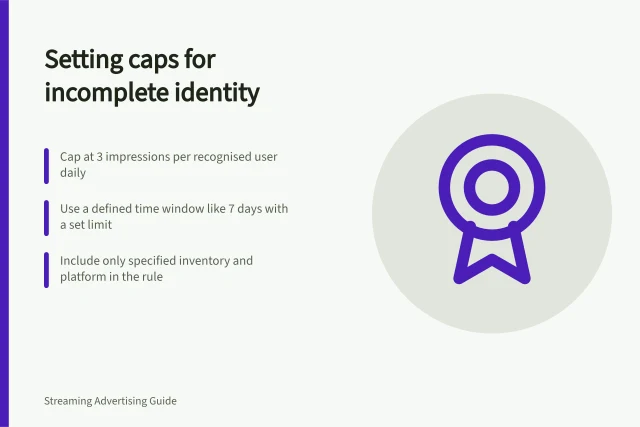
Choose a small, reversible next step: hold spend while refreshing a tired message, test a lower cap within inventory the buying platform covers, or shift a limited allocation toward an eligible placement that appears to add reach.
Set the decision rule and review period before the change. A campaign-level added-reach estimate from a frequency cap is a modelled comparison with its own coverage limits, not the causal return from an extra dollar of spend.
Keep publisher-level numbers separate when they cannot be deduplicated. Note any inventory outside the platform's identity graph. Then describe the conclusion at the level the evidence supports: repeated exposure rose within measured CTV delivery, rather than claiming that the whole audience has seen the ad too often.
Two readings of the same settled comparison
- Measured reach is still expandingExtra delivery can serve an awareness goal — but keep checking that each additional block of spend still adds reported reach.
- Repeated exposure is rising faster than reachAsk whether the reinforcement is deliberate, then refresh a tired message, test a lower cap within inventory the buying platform covers, or shift a limited allocation to an eligible placement that appears to add reach.
Testing a saturation hypothesis in six steps
- Compare consecutive settled periodsPut spend, impressions, estimated unique reach and the frequency distribution side by side on the same basis.
- Read the frequency distribution, not the average aloneLook for additional delivery that adds little reported reach while the heavily exposed tail grows.
- Review exposure alongside campaign outcomeCompleted plays or attributed actions do not, by themselves, prove that another CTV impression changed a viewer's decision.
- Choose a small, reversible next stepHold spend while refreshing the message, test a lower cap within covered inventory, or shift a limited allocation toward an eligible placement.
- Set the decision rule and review period firstAn added-reach estimate from a frequency cap is a modelled comparison with its own coverage limits, not the causal return from an extra dollar.
- Report at the level the evidence supportsSay repeated exposure rose within measured CTV delivery — not that the whole audience has seen the ad too often.