
Media Planning
Choosing contextual programmes or audience segments for CTV
Choose between CTV content context and an audience segment by checking message fit, data quality and eligible inventory.
Choose contextual CTV when the ad should fit what is being watched. Choose an audience segment when eligibility depends on a signal about an account, device or matched record. A cooking-equipment ad beside food programming fits context; a message for existing customers needs an eligible customer signal.
Compare signal fit, contextual classification level, segment provenance and eligible scale. If both approaches are needed, check whether the buy allows the combination and how much inventory remains eligible. Google Display & Video 360 names Connected TV targeting and Genre targeting; confirm availability and targeting level for the proposed Australian placement.
| Decision question | Contextual placement | Audience-segment targeting |
|---|---|---|
| What qualifies the opportunity? | An eligible app, content group or video genre that fits what is being watched | An eligible account, device or matched record that fits the intended audience |
| What needs checking? | Classification level and placement evidence | Segment definition, signal source, recency, refresh and activation coverage |
| How do you compare scale? | Eligible-inventory estimate for the proposed conditions | Eligible-inventory estimate for the same conditions |
| What can go wrong? | A broad label may not describe the programme | A segment may be inferred, stale or unavailable on the proposed supply |
Contextual Placement vs Audience-Segment Targeting for CTV in Australia
- What qualifies the opportunity?An eligible app, content group or video genre that fits what is being watched
- What needs checking?Classification level and placement evidence
- How do you compare scale?Eligible-inventory estimate for the proposed conditions
- What can go wrong?A broad label may not describe the programme
- What qualifies the opportunity?An eligible account, device or matched record that fits the intended audience
- What needs checking?Segment definition, signal source, recency, refresh and activation coverage
- How do you compare scale?Eligible-inventory estimate for the same conditions
- What can go wrong?A segment may be inferred, stale or unavailable on the proposed supply
Check how specific the context is
An app category is not programme-level targeting. Check how the platform defines and applies each control, and confirm whether the classification is at app, content-group, genre or programme level. A genre selection does not guarantee a named programme; if one matters, ask for a specific inventory commitment.
Google Display & Video 360 names Connected TV targeting and Genre targeting. Confirm which controls and inventory are available for the proposed Australian buy. Ask what placement reporting can show, because a contextual rule selected before booking may not produce programme-level reporting afterwards.
Inspect the segment
Ask what observed, declared or inferred signal places a record in the segment, who supplies it, how old qualifying data may be and how often the list is refreshed. Request the actual age and refresh terms rather than accepting an undefined recency claim.
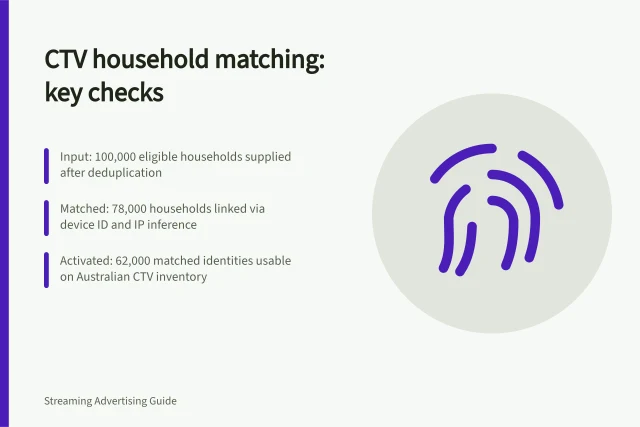
Establish whether the addressable unit is a person, account, household or device. A household or account qualification does not establish that the intended individual watched the ad.
Check the proposed segment on the proposed buy. Confirm which audience types, identifiers and combinations the platform supports for the actual Australian CTV placement; another supplier may offer different controls.
Pre-Booking Checklist: Contextual vs Audience Segments for CTV
- Verify signal type used for segmentObserved, declared or inferred
- Confirm data source and supplierIdentify provider of segment signal
- Check data recency and refresh frequencyRequest actual terms, not vague claims
- Determine addressable unitPerson, account, household or device
- Confirm platform support for Australian CTVCheck available audience types and identifiers
Compare eligible plans
Hold the required geography, TV-screen rule and dates steady. Request separate numeric eligible-inventory estimates for the contextual and segment plans, plus an estimate for their combination if it is proposed.
Show any data charge and reporting gaps beside the estimates. Choose according to message fit, classification specificity or data credibility, availability and cost.
Key Considerations for CTV Targeting in Australia
- Geography
- Australia
- TV-screen rule
- Confirmed for Australian placements
- Targeting platform
- Google Display & Video 360 (Connected TV & Genre targeting)
- Data charge risk
- Possible – check reporting gaps