Household Reach
Evaluating CTV household matching claims
Check a CTV household match claim through its denominator, identity method, validation and activation coverage.
Evaluate a CTV household-match claim by reconciling input, matched, activated and delivered counts, then checking how identities were linked, how errors were tested and what share of proposed Australian inventory can use the signal. A high match rate alone does not establish accurate household identity or usable TV impressions.
Separate match from activation
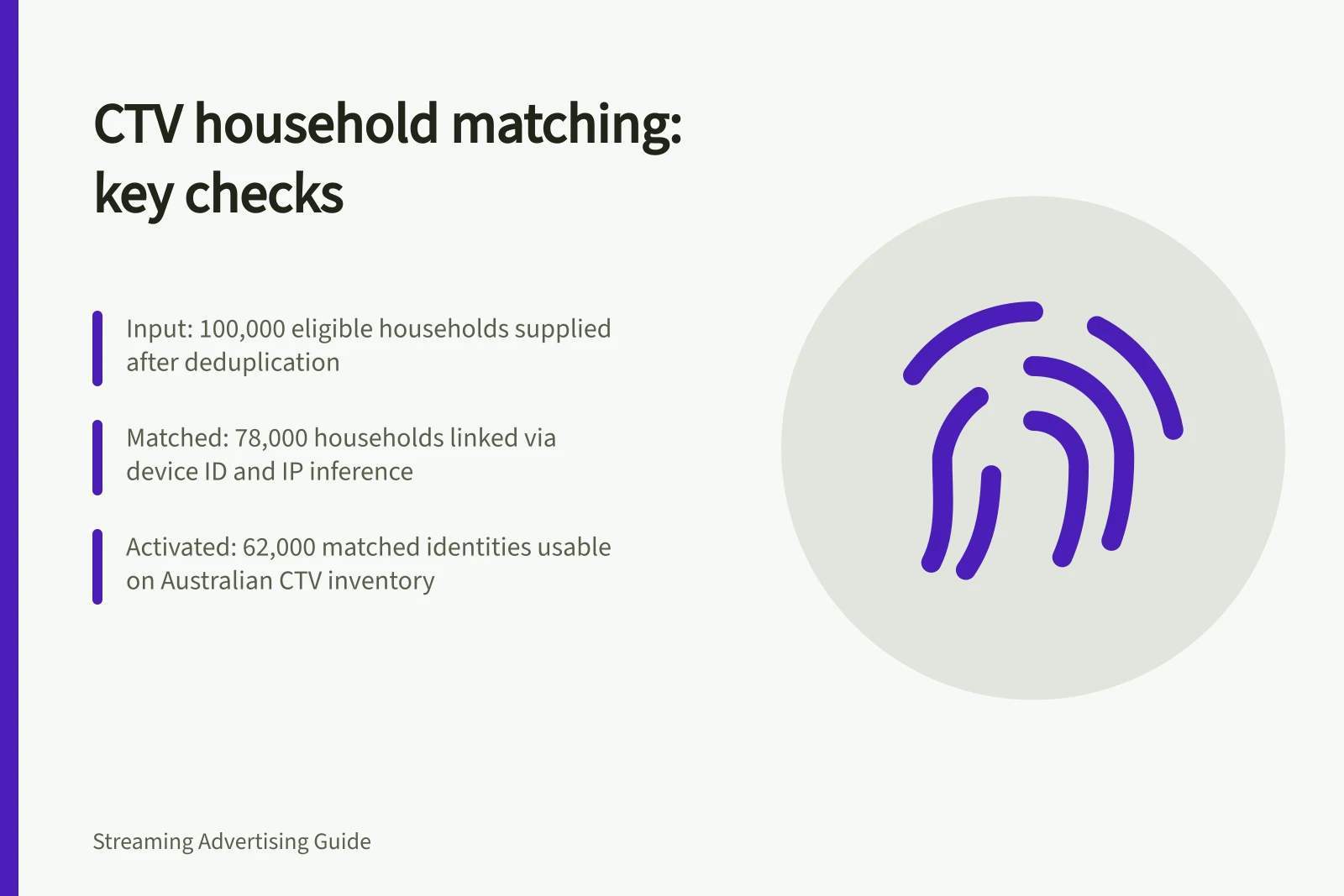
A supplier may use ‘household match’ for different steps. Require the count, unit, date and denominator at each stage: input records supplied; eligible records; matched records or deduplicated households; activated identities usable on the proposed inventory; and delivered ads or impressions.
- Input:How many eligible records or households were supplied after cleaning and deduplication?
- Matched:How many were associated with an addressable household or device under the supplier’s method?
- Activated:How many matched units can be recognised on the proposed Australian CTV inventory?
- Delivered:How many impressions actually served under that rule?
Ask which denominator produces the stated match rate: uploaded records, eligible records and deduplicated households produce different percentages. Check that numerator and denominator use the same unit; a file match rate is not campaign reach.
Reconcile the stages rather than comparing isolated percentages. A matched count does not show how many identities can be activated, and activation does not show how many ads were delivered. Ask the supplier to account for exclusions and dates so each count can be traced to the next.
Match Rate Denominators: Impact on Reported Accuracy
- Uploaded records
- Highest count; includes duplicates and invalid entries
- Eligible records (cleaned & deduplicated)
- Lower than uploaded; removes duplicates and non-compliant data
- Matched households
- Smaller still; reflects successful household associations
Examine the method
Ask the supplier to identify the data source and age, match keys, unit before and after onboarding, refresh cadence, and any expansion to related devices or similar records. The named disclosure reference is the IAB Tech Lab Data Transparency Standard Disclosure Schema 1.1. A completed disclosure describes a method; it does not certify its accuracy.
Ask whether the association uses a signed-in account, device identifier, address, IP-derived inference or a combination. IP-derived inference has limitations: guests can connect to an address, residents may never connect, and devices can use several IP addresses.
If matching uses personal information, check applicable handling against the Privacy Act 1988 (Cth) and the Australian Privacy Principles. The OAIC’s APP guidelines describe requirements and interpretation for organisations and agencies covered by the Act.
Ask how the supplier tested incorrect and missed links on a population relevant to the proposed Australian campaign. Request the test population, how correct links were established, and separate results for incorrect and missed links. For IP-derived location measurement, consult the MRC Location-Based Advertising Measurement Guidelines; a location measurement reference does not by itself validate a household association.
Decide what the evidence supports
Request validation findings, not just an assurance: the population and sample tested, how correct links were established, the test date, separate incorrect- and missed-link results, and limitations. Agree an acceptable error tolerance before booking; without measured error rates and an agreed tolerance, a match-rate percentage alone cannot establish accuracy.
Check which publishers, platforms and devices in the proposed Australian CTV buy can use the matched signal. Ask for the proposed inventory denominator, the activated inventory numerator in the same unit, the period covered, exclusions and the share of inventory without the signal.
Require a dated reporting specification that separates input, eligible, matched, activated and delivered counts and defines each unit and denominator. A household association does not identify every resident; claims should describe the matching method and the inventory on which ads can be delivered, not assert that every intended person watched an ad.