Media Planning
CTV audience targeting: signals, identity and brief
Plan Australian CTV audience targeting by checking the signal, its identity limits and deliverable TV inventory.
Start with the people a brand wants to reach, where its offer applies and the TV inventory it can buy. Choose a relevant signal, check identity limits and confirm the combined requirements are available.
Turn those decisions into a brief that separates mandatory conditions from preferences. A precise audience label is useful only if the proposed campaign can deliver against it.
Build the plan in layers
Set the conditions the campaign needs: service areas, dates, eligible TV screens and inventory exclusions. Keep refinements optional until the supplier confirms their combined effect on availability and delivery.
| Signal | What it can help select | What it cannot establish |
|---|---|---|
| Geography | Opportunities assigned to selected places | Every viewer’s exact home or current position |
| Content context | Eligible apps or video genres | The identity or interests of each viewer |
| Audience segment | Eligible accounts, devices or records associated with an attribute | That the intended person watched the ad |
| Household association | Records linked under a supplier’s method | Which resident was present |
Each condition should have a clear purpose in the brief. Adding requirements can reduce the eligible pool, so ask suppliers to check them together.
Pros and Cons of Signal Types in CTV Targeting
- GeographyPros: Targets specific regions. Cons: Cannot determine exact viewer location
- Content ContextPros: Aligns ads with relevant video genres. Cons: Does not confirm viewer interest or identity
- Audience SegmentPros: Reaches defined customer groups. Cons: Does not guarantee ad was seen by intended person
- Household AssociationPros: Links multiple devices under one account. Cons: Cannot identify which resident watched
Know the Australian CTV landscape
Australia has one cable TV provider, Foxtel; the US has ten. Free-to-air remains the dominant force in Australia, while about 80 per cent of US TV ad inventory sells wholesale during upfronts. Australian upfronts are more of a preview, and few advertisers commit early.
In a B&T interview, Mitch Waters, The Trade Desk’s general manager for Australia and New Zealand, said three out of four people in the US own a connected TV. He said The Trade Desk was running connected TV campaigns for a few Australian advertisers, and that Australia was not far behind the more mature US programmatic market.
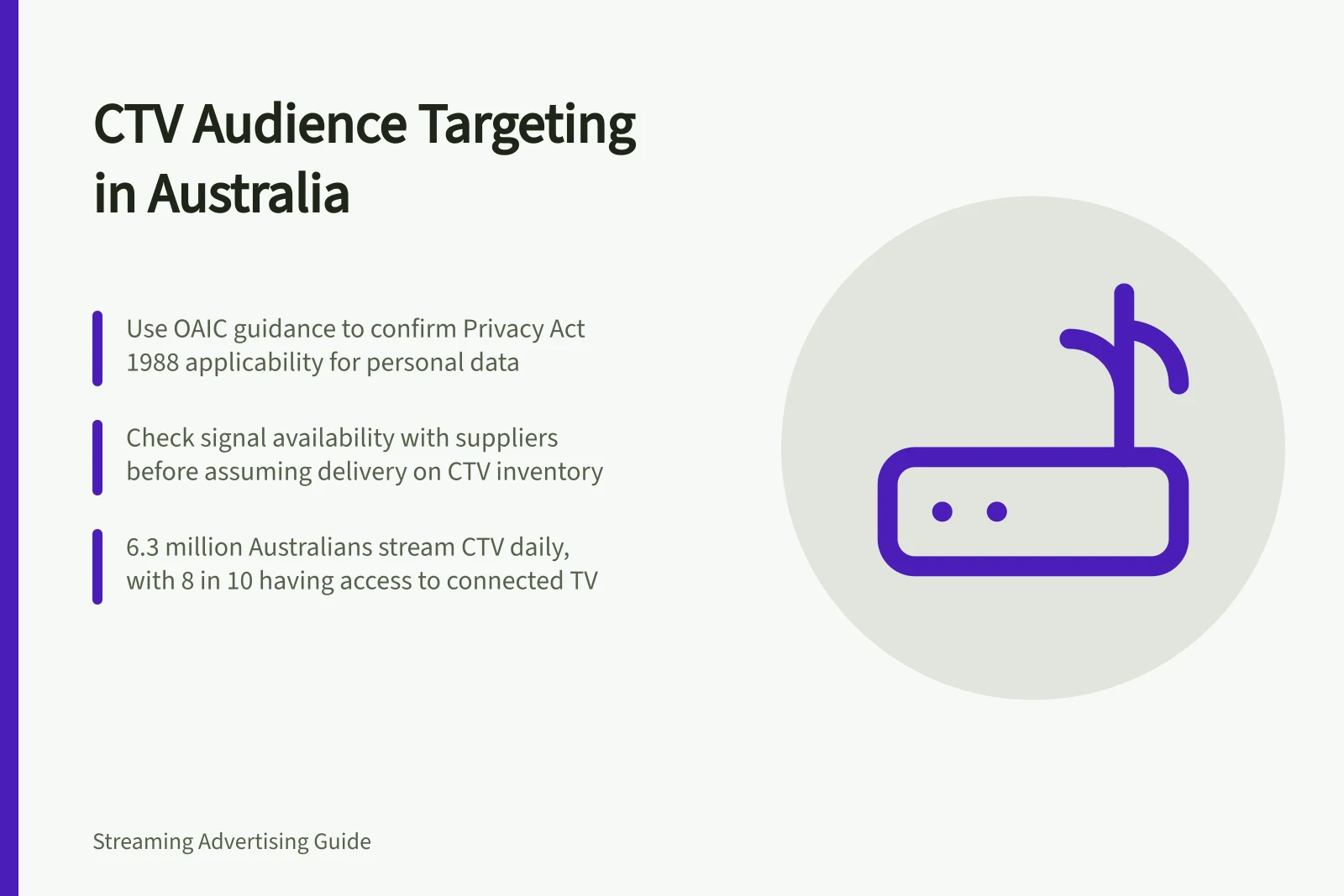
JSL Media states that 6.3 million Australian consumers stream CTV daily and 70 per cent of Australians aged 14 and older use streaming. It also states there are 6 or more average streaming devices per household and 8 in 10 Australian consumers have access to CTV. Treat these figures as broad audience context, not a forecast for a particular campaign.
Connected TV includes smart TVs, set-top boxes and dongles such as Roku and Amazon Fire TV. Broadcast video on demand (BVOD) is narrower: it covers broadcasters’ digital platforms, including 9Now, SBS On Demand and 7plus.
CTV also includes YouTube and Apple TV. The rise of internet TV, CTV and OTT has been driven by services such as Amazon, Netflix and Stan.
Some services are regarded as addressable because a platform can associate a user with a device and serve relevant ads. That does not establish whether a particular supplier targets a person, account, device or household, so confirm and record the identity unit.
Australian vs US Connected TV Market: Key Differences
- Free-to-Air Dominance
- High in Australia
- Upfronts Commitment Level
- Few advertisers commit early; more of a preview
- US TV Ad Inventory Sold Wholesale
- About 80%
- Daily CTV Streamers (Australia)
- 6.3 million
- CTV Access (Australia, aged 14+)
- 8 in 10 consumers
Key Australian CTV Audience Metrics
- 6.3Daily CTV Streamers
- 70%Australians Aged 14+ Using Streaming
- 6Average Streaming Devices per Household
- 8CTV Access Rate
Choose the signal and check its reach
Content context can suit a message related to what is being watched; an audience segment can suit a brief about a defined customer group. Ask what a platform’s context control represents and what signal basis supports a segment.
Do not assume contextual targeting guarantees placement in a named programme. If that placement is essential, request a specific inventory commitment.
The Trade Desk and JSL Media are starting points for an Australian availability check, not confirmation that a particular signal is available. Ask the relevant buyer and publisher whether the signal is supported for the account, deal and CTV inventory, and which identity unit it uses.
Request confirmation of the complete combination of locations, dates, inventory and signals before relying on it. Keep any unconfirmed requirement marked as unconfirmed in the brief.
Respect identity limits and consent
The Privacy Act 1988 (Cth) applies to Australian Government agencies, organisations with annual turnover above $3 million and some other organisations. Its 13 Australian Privacy Principles (APPs) apply to some private sector organisations and most Australian Government agencies.
Use OAIC guidance to check whether the Privacy Act applies and what APP handling is relevant to the campaign. The OAIC describes targeted online marketing as matching ads with a person’s interests; cookies can attach interest categories, and advertising networks may track browsing activity across sites.
An Irish Data Protection Commission ruling said businesses could not rely on contractual necessity for behavioural advertising in the matter it considered. That Irish decision is not Australian law and does not determine an Australian campaign’s requirements.
For personal information, record the Privacy Act applicability assessment, relevant APP review and any consent status confirmed for the campaign by privacy or legal advisers. Do not assume the same identity basis or privacy treatment applies to every signal.
Forecast the combination
Ask for an estimate using the specified locations, TV inventory, dates and targeting rules together. Request eligible impressions and, where available, estimated reach with its unit and coverage stated.
A national streaming audience figure cannot show whether a particular combination will deliver. Make the supplier’s confirmation and forecast assumptions part of the planning record.
For example, a retailer serving selected areas might make those areas mandatory while keeping a home-improvement genre optional. If an additional inferred segment makes the plan too small, the retailer can consider a broader contextual plan while preserving its service boundary; that is a planning choice, not a performance prediction.
Finalise the audience brief
State the intended customer, required service areas, dates, eligible screens and inventory exclusions. Name the selected signal and supplier, define its identity unit and signal basis, and separate optional refinements from mandatory conditions.
Record whether the supplier confirmed the full combination, along with the forecast assumptions and the unit used for any estimated reach. Include the Privacy Act applicability assessment, relevant APP review and consent status confirmed for any personal data used.
Keep unconfirmed requirements explicit rather than treating them as available. This leaves the buyer and supplier with a clear audience plan to check before the campaign is booked.
Final Steps Before Booking a CTV Campaign
- Confirm mandatory conditions onlySeparate optional refinements from required criteria
- Verify signal and identity unit supportCheck with buyer and publisher whether the signal is available
- Document forecast assumptionsNote units used for reach and impression estimates
- Keep unconfirmed requirements visibleDo not treat them as available until confirmed
In this guide
- Choosing contextual programmes or audience segments for CTVChoose between CTV content context and an audience segment by checking message fit, data quality and eligible inventory.
- Checking geographic coverage for Australian campaignsCompare Australian service areas with CTV location controls, eligible TV inventory and geographic reporting.
- Evaluating CTV household matching claimsCheck a CTV household match claim through its denominator, identity method, validation and activation coverage.
- Avoiding overly narrow CTV targeting that prevents deliveryEstimate combined CTV targeting scale, locate delivery loss and revise optional rules when targeting is the constraint.