Creative Specs
Part of CTV creative experimentation
Testing a shorter edit against a longer product explanation
Compare short and long CTV edits on product understanding and comparable delivery, with completion rates and placement differences in context.
A shorter CTV edit gives viewers less to watch but also less room for explanation. Before testing, decide what viewers must understand and compare the edits with the same offer and comparable delivery.
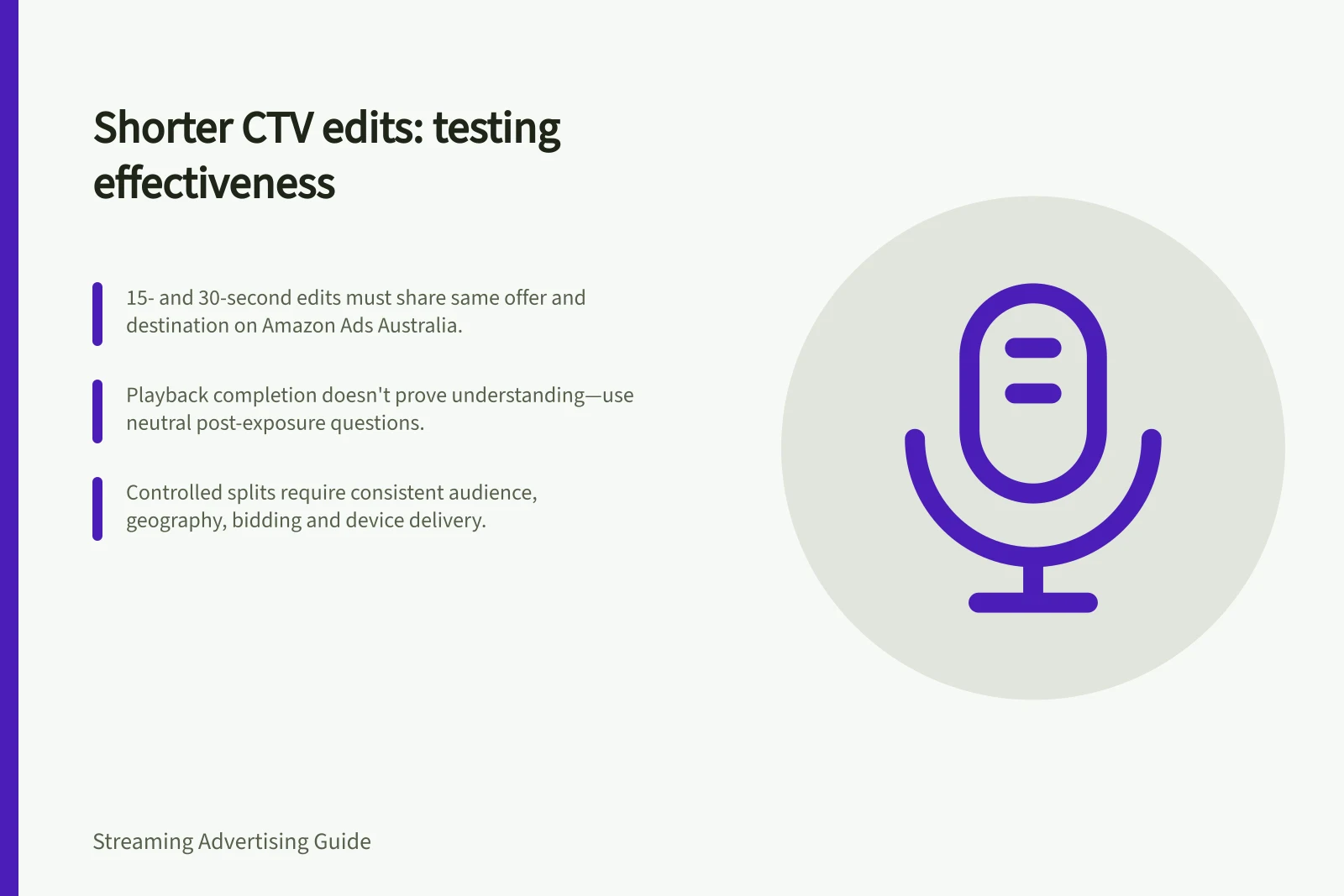
Completion alone cannot show whether viewers understood the message. Read playback and understanding as separate outcomes.
Define what each edit says
Set one intended takeaway and the information needed to support it. For a hypothetical appliance, a 15-second edit could show the result and name the household task it solves; a 30-second edit could show two steps as well as the result.
Keep the product, main claim, offer conditions and destination consistent. Record what the shorter edit removes so the comparison tests explanatory detail as well as duration.
For an explanatory ad, ask both groups the same neutral post-exposure question about what the product does and which task it solves. Decide in advance what answers demonstrate the intended takeaway; if the goal is a later action, define the same action and measurement for both groups.
Keep the chosen outcome separate from delivery measures such as impressions and spend. Do not assume the shorter asset costs less to produce or buy without an actual quote.
Find inventory that accepts both lengths
Amazon Ads lists Australian Prime Video durations of 15, 20, 30, 40 and 60 seconds. Its Australian 3P STV Apps listing gives 6, 10, 15, 20, 30, 45, 60, 75 and 90 seconds, so both 15- and 30-second edits appear in those duration lists.
The Australian listing gives no duration options for Twitch or Fire TV Channels. Amazon Ads says any duration is acceptable on 3P Exchange inventory at the publisher’s discretion, so confirm acceptance for the actual placement rather than assuming the published options guarantee a booking.
Ask the supplier whether both edits can run in the same booked placement and whether the buying path supports a controlled split. If each duration requires different inventory or a different format, report the result as a comparison of those packages and name the differences.
If a controlled split is supported, randomly assign eligible delivery between the versions and keep audience, dates, geography, bidding approach, frequency policy and placement consistent. Give each approved script and delivered asset a stable ID, and record actual delivery by version, publisher and device.
CTV Inventory Availability for Australian Prime Video (Amazon Ads)
- Supported Durations (Prime Video)
- 15, 20, 30, 40, 60 seconds
- Supported Durations (3P STV Apps)
- 6, 10, 15, 20, 30, 45, 60, 75, 90 seconds
- Twitch & Fire TV Channels
- No published duration options in Australia
- 3P Exchange Flexibility
- Any duration accepted at publisher discretion
Interpret the result
First check impressions, spend, inventory mix and exposure period for each version. Report playback starts and completions, with the denominator for each rate stated.
A completion rate describes playback, not comprehension. Because the edits have different durations, a rate comparison answers a narrow playback question; it cannot establish which edit explained the product better.
Compare responses to the preselected understanding question separately from completion. Include the usable response or event coverage and uncertainty, and set an acceptable understanding standard and tolerable difference between edits before the test.
The short edit may suit the placement if it meets the agreed understanding standard. If the short edit misses it and the longer edit meets it, the extra explanation may be warranted; if the evidence cannot support either conclusion, treat the result as inconclusive rather than forcing a winner.
Pros and Cons of Shorter vs Longer CTV Edits
- Short Edit – ProsHigher completion likelihood due to brevity; better fit for high-freedom placements; lower production cost potential
- Short Edit – ConsLess room for explanation; risk of reduced comprehension; may omit critical steps or context
- Long Edit – ProsMore space to explain features and benefits; stronger message retention; supports complex product stories
- Long Edit – ConsLower completion rates; higher production and media costs; less suitable for interruptive placements