Delivery Ops
Part of CTV campaign delivery operations
Negotiating makegoods after CTV underdelivery
Use a confirmed CTV shortfall and booking terms to assess replacement inventory, timing, fees and billing adjustments.
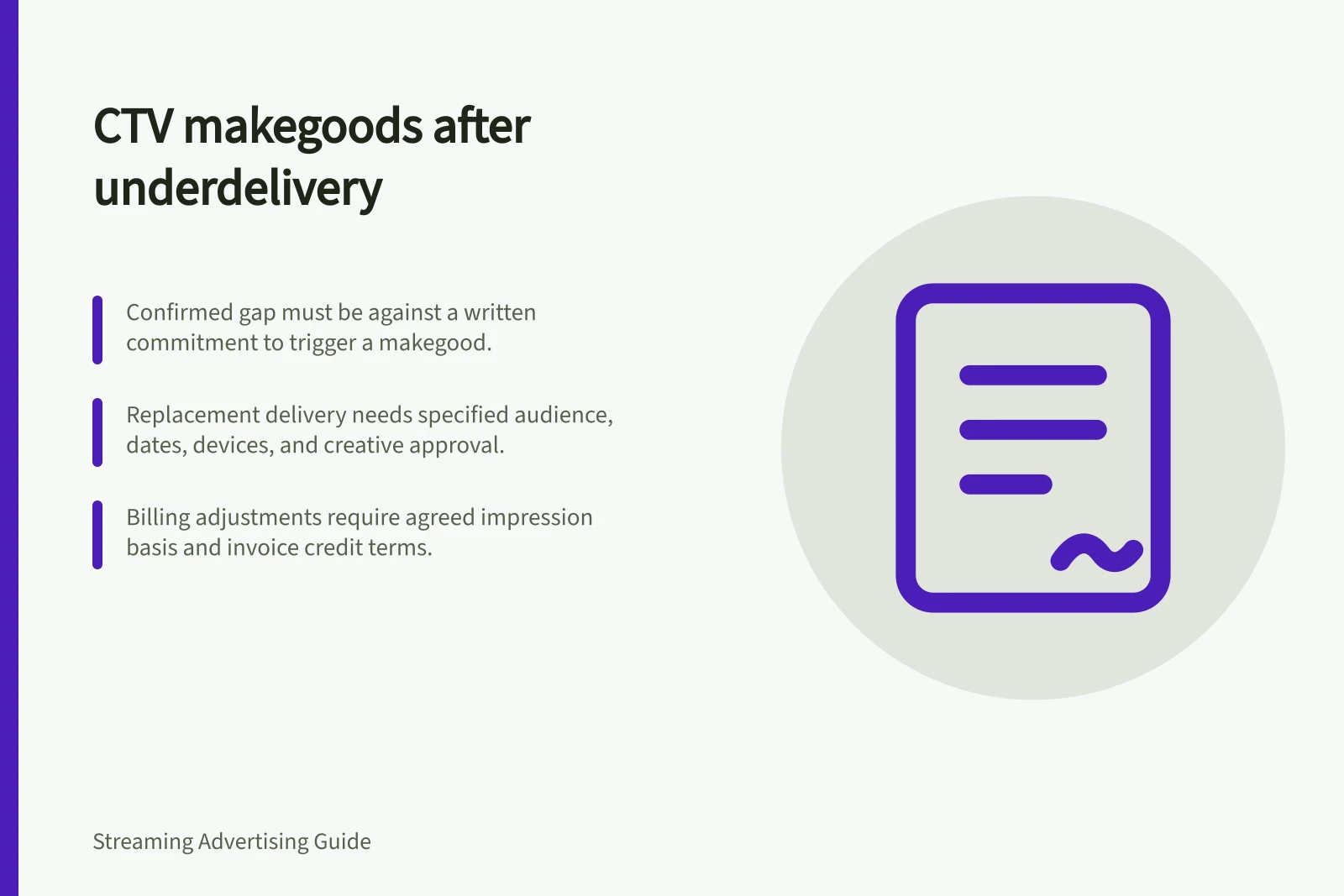
Start a CTV makegood discussion with a confirmed gap against a written commitment. Show the booked scope, qualifying delivery and cause where known. Judge a proposed remedy by the audience, TV inventory, dates and value it can still provide. A dashboard trailing a forecast does not create a makegood entitlement.
Establish the claim
Separate a guaranteed quantity from a non-guaranteed estimate or auction opportunity. Reconcile reports under the booking’s counting and dispute terms. Record approved changes, creative delays and any period when the buyer’s asset could not serve. The order and applicable supplier terms determine what remedy is available.
Ask for a dated explanation and recovery proposal while useful campaign time remains. If eligible inventory cannot close the gap within the original flight, decide whether later delivery still serves the message. Impressions after an offer expires may have little value.
Compare the proposed remedies
For replacement delivery, specify the quantity, eligible TV devices, services, Australian locations, audience rule, creative, dates, price and reporting method. Confirm whether it covers only the shortfall or changes other terms. Ask how buying, serving and verification fees will be treated.
| Option | Question to settle |
|---|---|
| Delivery within the original flight | Is suitable inventory available before the message expires? |
| Later replacement flight | Does the later audience and context still meet the objective? |
| Billing adjustment | What amount and impression basis will appear on the invoice or credit? |
These are negotiation options, not remedies promised by every agreement. Do not treat mobile or desktop video as equivalent to a booked TV-screen placement without approval. If named publisher inventory was required, check that any replacement preserves it.
Check the actual platform limits
Google Display & Video 360’s cited makegood guidance is specifically for Programmatic Guaranteed deals. Do not assume that process applies to other deal types.
Google Ad Manager has a separate “Give buyers Makegoods” workflow. Confirm which platform and deal type governs the booking before applying a process.
Platform-Specific Makegood Guidance: Key Differences
- Google Display & Video 360
- Makegood process applies only to Programmatic Guaranteed deals.
- Google Ad Manager
- Uses a dedicated ‘Give buyers Makegoods’ workflow.
- General Note
- Do not assume standard makegood processes apply across all deal types.
Record and verify the agreement
Put the accepted remedy in writing with its booking or deal reference, approval owner, qualifying inventory, dates, quantity, fees and billing treatment. Check creative acceptance for any replacement placement. Report original and replacement delivery separately to avoid double counting.
At close, compare replacement delivery with the agreed remedy and reconcile the invoice or credit. Record any count that remains disputed. The decision is whether the remedy meets the original campaign purpose under the terms the parties accepted.

![Manage ad versions across streaming suppliers: Use a unique message ID pattern like [campaign]_[message]_[language]_[date]_v[number]; Specify exact delivery asset IDs and permitted dates for each supplier and placement; Confirm rotation rules and reporting with suppliers before launch. Managing several ad versions across streaming suppliers](/covers/managing-several-ad-versions-across-streaming-suppliers-640.webp?v=0479db80)
